


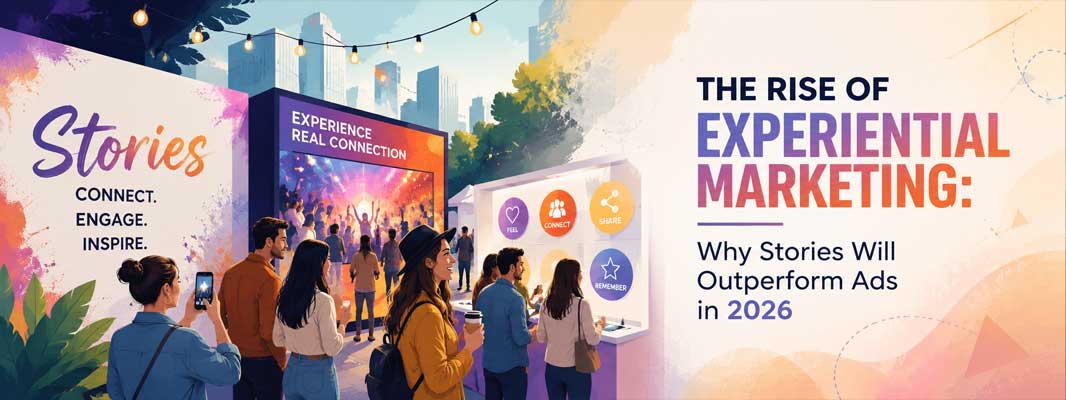
02 Feb The Rise of Experiential Marketing: Why Stories Will Outperform Ads in 2026
Why Traditional Advertising Is Losing Its Impact
By 2026, audiences are surrounded by more advertising than ever before. Automated ad creation, AI-generated copy, and endless promotional formats have made advertising easier to produce—but far easier to ignore. Consumers have developed strong instincts for filtering out messages that feel intrusive, transactional, or disconnected from their values.
This growing fatigue is forcing brands and organisations to rethink their approach. Rather than competing for attention, successful marketers are focusing on connection. As discussed in How AI-Powered Search Will Change Website Content in 2026, visibility alone no longer guarantees influence. Meaningful engagement now depends on trust, relevance, and emotional resonance.
What Experiential Marketing Means in 2026
Experiential marketing in 2026 is defined less by spectacle and more by substance. It centres on creating moments that invite audiences to participate, reflect, and feel something memorable. These experiences may be physical, digital, or a blend of both, but they are always rooted in storytelling.
Whether through a cultural event, an immersive installation, or a thoughtfully designed online experience, experiential marketing allows audiences to engage with a brand’s values rather than its sales message. Stories provide the framework, guiding audiences through an experience that feels personal rather than promotional.
Why Stories Create Deeper Connections
Stories shape how people understand brands in ways advertisements cannot. While ads communicate what a product does, stories reveal why it exists and who it serves. This distinction becomes increasingly important as audiences seek authenticity in an era dominated by automation.
Narrative-driven marketing invites audiences into a shared experience. It encourages curiosity, emotional connection, and long-term memory. This approach mirrors the principles outlined in Editorial Authority in the AI Age, where credibility and consistency are shown to be critical for building trust in an AI-driven content landscape.
The Enduring Power of Real-World Experiences
Despite digital innovation, physical experiences remain deeply influential. In a screen-heavy world, real-world interaction feels human, grounding, and distinctive. Events such as festivals, exhibitions, tastings, and workshops offer opportunities for connection that extend beyond a single moment.
These experiences generate authentic stories—shared through conversation, photography, and social content—that continue long after the event ends. When supported by strong editorial storytelling, real-world experiences become powerful marketing assets rather than fleeting activations.
Immersive Content Extends the Story
Experiential marketing does not stop when an event concludes. Immersive content allows experiences to live on through editorial features, video storytelling, and behind-the-scenes narratives that capture atmosphere and meaning.
This content transforms moments into stories that can be discovered, shared, and revisited. In an AI-powered search environment, such narrative-rich content is more likely to be referenced and trusted, reinforcing long-term visibility rather than short-lived attention.
Narrative-Driven Marketing Builds Trust
Trust has become a defining factor in how audiences engage with brands. Narrative-driven strategies focus on showing rather than telling, allowing values, process, and community involvement to speak for themselves.
By highlighting collaboration, creativity, and cultural relevance, experiential marketing aligns naturally with trust-based engagement. This human-centred approach contrasts sharply with algorithmic advertising, offering audiences something they cannot get from automated content alone.
Technology as a Supporting Role
Artificial intelligence plays a supporting role in experiential marketing, helping brands analyse behaviour, personalise outreach, and extend reach. However, AI cannot replace the emotional depth of real experiences or the authenticity of human stories.
In 2026, the most effective campaigns will use technology to enhance storytelling rather than dominate it. Experiences grounded in reality will stand out precisely because they cannot be replicated by machines.
Measuring Impact Through Meaningful Engagement
The success of experiential marketing is measured less by impressions and more by connection. Engagement, conversation, return visits, and community growth offer far more insight into long-term impact than traditional advertising metrics.
Stories that resonate encourage loyalty and advocacy—outcomes that cannot be bought through advertising alone. As brands reassess how they define success, experiential marketing offers a more sustainable and human approach.
Why Stories Will Always Outperform Ads
Experiential marketing succeeds because it respects audiences as participants rather than targets. It creates space for connection, emotion, and shared meaning. In an era shaped by automation and AI, these qualities have become invaluable.
In 2026, stories will outperform ads not because they are louder or more frequent, but because they are remembered. They build trust, foster community, and transform fleeting moments into lasting relationships.