



18 Jun 5 Signs Your Website Isn’t Ready for AI Search
The way people search online is changing faster than ever. For years, businesses focused on traditional search engine optimisation (SEO) to improve rankings and attract website visitors. While SEO remains essential, a new challenge has emerged.
Consumers are increasingly using AI-powered platforms such as ChatGPT, Google AI Overviews, Gemini, Claude and Perplexity to find information, compare products, and discover businesses. Instead of browsing through multiple websites, users often receive instant summaries and recommendations generated by artificial intelligence.
As a result, businesses need to think beyond traditional rankings. The question is no longer whether your website appears in search results. The question is whether AI systems can find, understand, and trust your content.
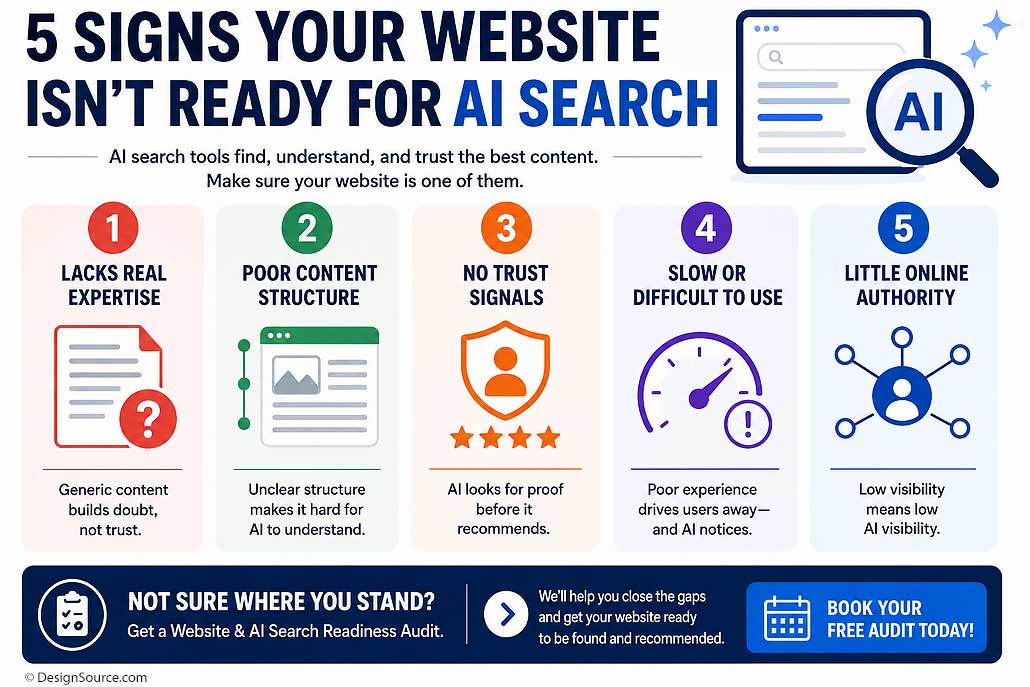
Here are five signs your website may not be ready for AI search.
Sign #1: Your Content Lacks Real Expertise
AI search tools are becoming increasingly effective at identifying content that demonstrates genuine expertise.
Many websites publish generic articles that repeat information already available elsewhere. While this content may fill pages, it does little to establish authority.
AI platforms are more likely to reference content that includes:
- Real-world experience
- Industry expertise
- Original insights
- Case studies
- Customer success stories
- Professional opinions
If your website primarily contains surface-level content, AI systems may view it as less valuable than competitors offering deeper expertise.
Businesses should focus on creating content that reflects actual experience and provides unique value to readers.
Sign #2: Your Website Has Poor Content Structure
Even excellent content can be difficult for AI systems to understand if it is poorly organised. AI tools rely on a clear structure to identify key information and generate accurate responses. Common problems include:
- Missing headings
- Large blocks of text
- Poor navigation
- Inconsistent formatting
- Unclear page hierarchy
Well-structured content benefits both users and AI systems. Clear headings, bullet points, frequently asked questions, and logical content organisation make it easier for information to be discovered and referenced.
If your website feels confusing to visitors, it is likely confusing to AI as well.
Sign #3: You Have No Supporting Trust Signals
Trust has become one of the most important factors in digital visibility. AI search tools often evaluate signals that help determine whether a business is credible and authoritative. Important trust signals include:
- Customer reviews
- Testimonials
- Case studies
- Professional certifications
- Industry recognition
- Author information
- Contact details
Many small businesses overlook these elements. Yet they play a significant role in helping both people and AI systems determine whether a source can be trusted.
A website that lacks visible proof of expertise may struggle to gain visibility in AI-generated recommendations.
Sign #4: Your Website Is Slow or Difficult to Use
User experience has always been important, but it is becoming even more critical. Search engines and AI platforms increasingly favour websites that provide positive user experiences. Warning signs include:
- Slow page loading times
- Poor mobile performance
- Difficult navigation
- Broken links
- Outdated design
- Accessibility issues
Visitors expect fast, seamless experiences regardless of the device they are using.
A modern website should not only look professional but also function efficiently. Poor usability can reduce engagement, increase bounce rates, and negatively affect search visibility.
Sign #5: Your Brand Has Little Online Authority
AI search systems do not evaluate websites in isolation. They also consider how often a business is mentioned across the internet and whether those mentions appear on credible sources.
Questions AI systems may effectively ask include:
- Is this business recognised within its industry?
- Is it mentioned on trusted websites?
- Does it publish useful content regularly?
- Are customers talking about it online?
Businesses with strong digital footprints often have an advantage.
This is why public relations, guest articles, industry partnerships, social media engagement, and thought leadership content are becoming increasingly important components of digital marketing.
If your brand has little visibility beyond its own website, AI search tools may have limited evidence to support recommending it.
Why This Matters
The rise of AI-powered search is changing how customers discover businesses.
Instead of clicking through pages of search results, users are increasingly relying on AI-generated recommendations and summaries. Businesses that fail to adapt may find themselves becoming less visible, even if their traditional search rankings remain relatively strong.
The good news is that many of the improvements required for AI search readiness also strengthen traditional SEO, user experience, and conversion performance.
What Businesses Should Do Next
Preparing for AI search does not require starting from scratch. A strong strategy includes:
- Publishing expert-driven content
- Improving website structure
- Building trust signals
- Enhancing user experience
- Strengthening brand authority
- Creating original case studies
- Investing in quality content and design
Businesses that take these steps today will be better positioned as AI search continues to evolve.
The Bottom Line
AI-powered search is not a future trend. It is already influencing how customers find information and make purchasing decisions.
The businesses that succeed in this new environment will be those that combine strong website design, clear content structure, genuine expertise, and credible online authority.
If your website is not prepared for AI search, now is the time to evaluate its strengths and weaknesses. The sooner businesses adapt, the better positioned they will be to attract qualified visitors and remain visible in the next generation of search.