


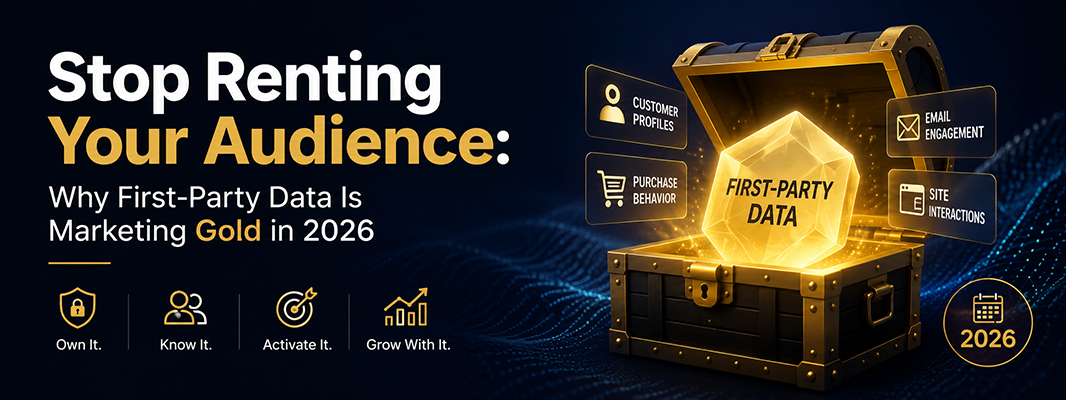
10 Jul Stop Renting Your Audience: Why First-Party Data Is Marketing Gold in 2026
Social media has transformed how businesses connect with customers. A single post can reach thousands of people in minutes, making platforms like Facebook, Instagram, LinkedIn, and TikTok attractive marketing tools for small businesses.
However, many business owners are discovering a hard truth in 2026: social media followers do not belong to them.
Algorithms, platform changes, and AI-driven content recommendations increasingly control who sees business content. As organic reach declines and competition grows, many companies are finding it harder to engage the audiences they worked so hard to build.
That is why first-party data has become one of the most valuable assets a business can own.
What Is First-Party Data?
First-party data is information collected directly from customers and prospects.
This may include:
- Email subscribers
- Customer databases
- Loyalty programme members
- Purchase histories
- Customer preferences
- Survey responses
Unlike social media followers, this data belongs to the business. No algorithm controls access to it, and no platform can suddenly reduce visibility.
For small businesses, first-party data creates a direct line of communication with existing and potential customers.
The Problem With Relying on Social Media Alone
Many businesses invest significant time and resources growing their social media presence.
While social platforms remain important marketing channels, they come with limitations.
Algorithms determine which content appears in users’ feeds. Even if a business has thousands of followers, only a small percentage may see a particular post.
Platforms can also change their rules, introduce new advertising costs, or alter how content is distributed. Businesses have little control over these decisions.
In effect, companies are renting access to an audience rather than owning the relationship.
Why Email Lists Still Deliver Results
Despite the popularity of social media, email marketing remains one of the most effective digital marketing tools available.
An email list allows businesses to communicate directly with people who have already expressed interest in their products or services.
Unlike social media posts, emails do not compete with endless scrolling, algorithm updates, or trending content.
Businesses can share promotions, updates, educational content, and personalised offers directly with their audience.
More importantly, the relationship belongs to the business, not the platform.
Building Stronger Customer Relationships
First-party data is about more than collecting email addresses.
It helps businesses understand customer behaviour, preferences, and purchasing patterns. This information allows for more relevant and personalised marketing.
A loyalty programme, for example, can reward repeat customers while providing valuable insights into buying habits. Customer databases can help businesses tailor offers and improve service.
These direct relationships often lead to higher engagement, stronger loyalty, and increased customer lifetime value.
Preparing for an AI-Driven Future
Artificial intelligence is changing how people discover products, services, and information online.
As AI platforms increasingly filter and recommend content, businesses that rely solely on social media may find their visibility becoming even more unpredictable.
First-party data provides stability in an environment that continues to evolve.
By building email lists, customer databases, and loyalty programmes, businesses create marketing channels they control regardless of platform changes.
The Takeaway
In 2026, successful businesses understand that followers are valuable, but ownership is even more important.
Social media should remain part of a marketing strategy, but it should not be the entire strategy. Email subscribers, customer databases, loyalty programmes, and direct relationships provide long-term value that no algorithm can take away.
The businesses that invest in first-party data today will be better positioned to build stronger customer relationships, improve marketing performance, and maintain control over their audience tomorrow.