


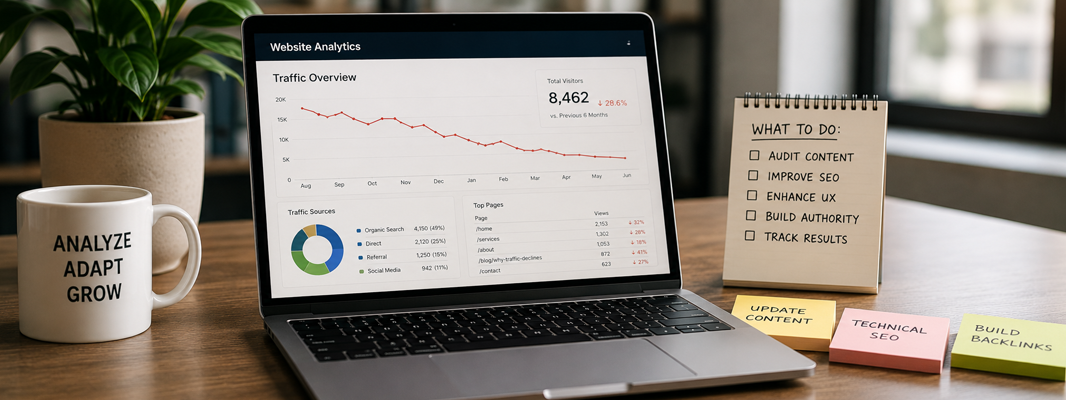
05 Mar Why Your Website Traffic Is Declining (And What to Do About It in 2026)
Many business owners are facing a frustrating reality in 2026. Their websites are well-designed, regularly updated, and rank reasonably well in search results, yet traffic numbers continue to decline.
For years, search engine optimisation (SEO) focused on helping websites appear on the first page of Google. While SEO remains important, the way people discover information online is changing rapidly. Artificial intelligence, voice search, featured snippets, and AI-generated answers are transforming how users interact with search engines.
As a result, businesses that once relied heavily on organic search traffic are seeing fewer visitors arrive on their websites. Understanding why this is happening is the first step toward adapting and maintaining a strong online presence.
The Rise of Zero-Click Searches
One of the biggest changes affecting website traffic is the growth of zero-click searches.
A zero-click search occurs when a user receives the information they need directly from the search results page without visiting a website. Search engines now provide answers, summaries, maps, business information, reviews, and frequently asked questions directly within the results.
For example, someone searching for “What is responsive web design?” may receive an AI-generated overview that answers the question immediately. While the information may originate from various websites, users often have no need to click through to the original source.
This shift means businesses can appear in search results while receiving significantly fewer website visits.
AI Is Changing Search Behaviour
The introduction of AI-powered search experiences has accelerated this trend. Instead of reviewing multiple websites, users increasingly rely on AI-generated summaries to answer questions, compare products, and gather information. Search engines are becoming answer engines.
This doesn’t mean websites are no longer important. In fact, websites remain the foundation of online credibility. However, businesses must now optimise their content not only for traditional search rankings but also for AI systems that gather and summarise information.
Websites that provide clear, authoritative, and well-structured content are more likely to be referenced by AI-powered search tools.
Ranking Well Doesn’t Guarantee Traffic
Many business owners assume that reaching the first page of search results guarantees success.
In 2026, that assumption is no longer accurate.
Search engine results pages contain a variety of elements competing for attention, including:
- AI-generated summaries
- Featured snippets
- Local business listings
- Knowledge panels
- Video content
- Shopping results
- Social media content
Even a first-page ranking may appear below several of these features, reducing the likelihood of a click.
Businesses should focus not only on rankings but also on visibility across the entire search experience.
Generic Content Is Losing Value
Over the past few years, the internet has become flooded with AI-generated articles covering similar topics.
As a result, generic content is becoming less effective at attracting visitors.
Search engines and AI platforms increasingly favour content that demonstrates genuine expertise, practical experience, and original insights. Articles that simply repeat information already available elsewhere provide little value to users.
Businesses should focus on creating content that showcases their unique knowledge, real-world projects, case studies, customer success stories, and industry experience.
Authenticity has become a competitive advantage.
User Experience Matters More Than Ever
Traffic alone is no longer the most important metric.
If visitors arrive on a website but quickly leave because the experience is poor, search engines and AI systems may interpret the site as less valuable.
Key factors influencing user experience include:
- Mobile responsiveness
- Fast page loading speeds
- Clear navigation
- Accessibility
- High-quality visuals
- Easy-to-read content
- Strong calls to action
A website should help visitors quickly find what they need while encouraging further engagement.
Businesses that invest in user experience often see better conversion rates, even if overall traffic numbers are lower than in previous years.
Building Authority Beyond Search
Many companies still rely too heavily on Google for website traffic.
A more resilient marketing strategy includes multiple channels that work together to build visibility and trust.
Effective traffic sources may include:
- Email marketing
- Industry partnerships
- Social media platforms
- Digital publications
- Podcasts
- Online communities
- Video marketing
- Public relations
When businesses diversify their marketing efforts, they become less vulnerable to changes in search engine algorithms and AI search features.
What Businesses Should Do Next
The decline in website traffic does not necessarily indicate a failing website or poor SEO strategy. In many cases, it reflects broader changes in how people search for and consume information online.
To remain competitive in 2026, businesses should:
- Continue investing in SEO fundamentals
- Create original, expert-driven content
- Improve website user experience
- Strengthen brand authority
- Diversify traffic sources
- Optimise content for AI discovery
- Focus on conversions rather than traffic alone
The companies that adapt to these changes will be better positioned to attract qualified visitors, generate leads, and build long-term digital success.
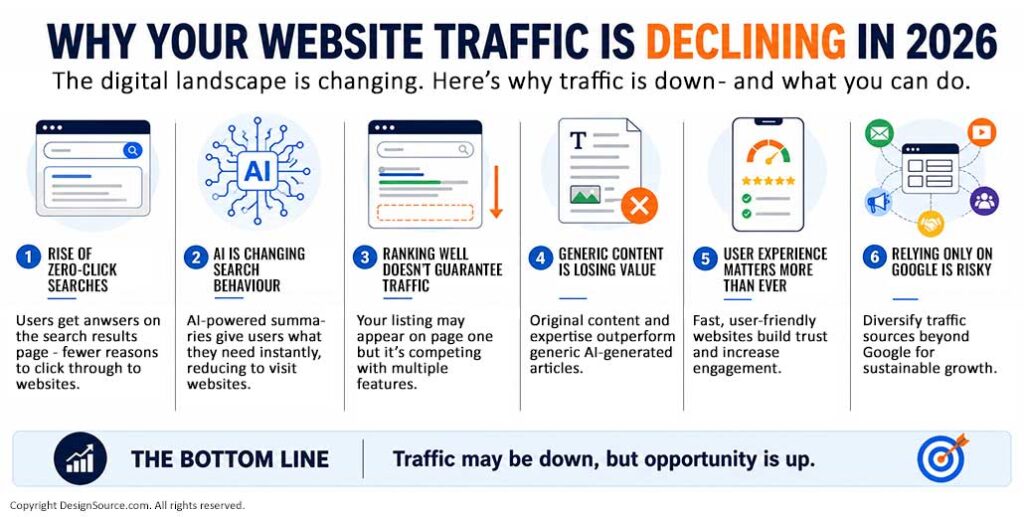
The Bottom Line
The digital landscape is evolving faster than ever. While traditional SEO remains important, businesses can no longer rely solely on rankings to drive website traffic.
Success in 2026 requires a broader strategy that combines search visibility, user experience, authoritative content, and brand credibility.
Rather than chasing traffic numbers alone, smart businesses are focusing on creating meaningful online experiences that attract, engage, and convert the right audience. Those who embrace this shift will be well-equipped to thrive in the age of AI-powered search.